

science
DHA and Omega-3: From fish to modern nutrition science
Nutrition with care, for family life
In the early 1970s, the Danish researchers Hans Olaf Bang and Jørn Dyerberg travelled to Greenland with a question. Could the traditional diet of Greenland's Inuit communities help explain some of the health patterns they had observed?
Dietary fats were attracting growing attention in nutrition science at the time, but knowledge about the different types of polyunsaturated fatty acids was far less established than it is today.
The researchers collected blood samples and studied the local diet, which included substantial amounts of fish and other marine foods. Their work revealed unusual fatty-acid profiles compared with those typically seen in Denmark, and turned scientific attention towards long-chain polyunsaturated fatty acids of marine origin.¹
Those early observations did not provide all the answers. Some of the original interpretations have since been questioned and refined as research has progressed. But the work helped open an important new field of study.
In the decades that followed, researchers began to look beyond "fish oil" as a single concept and instead study the individual fatty acids — above all EPA and DHA.
What began as observations of marine diets gradually grew into one of the most studied areas of modern nutrition science.

What is Omega-3, and why does DHA matter?
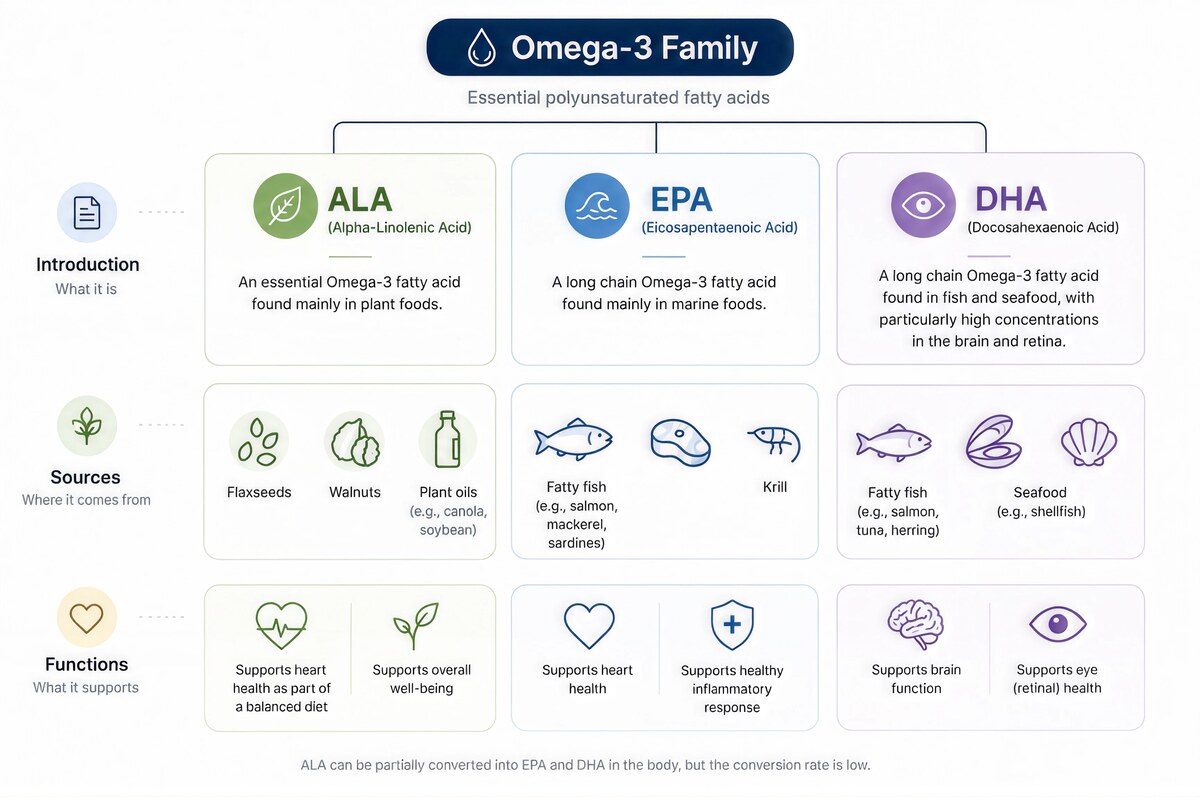
Omega-3 is not a single nutrient. It is a family of polyunsaturated fatty acids, and the members of that family play different roles in human nutrition.
ALA
Alpha-linolenic acid is found mainly in plant foods such as flaxseed, walnuts and certain vegetable oils. It is an essential fatty acid, which means we need to get it through our diet.
EPA
Eicosapentaenoic acid is a long-chain Omega-3 fatty acid found mainly in fish and other marine foods. It is involved in several physiological processes and has been studied extensively in nutrition and cardiovascular research.
DHA
Docosahexaenoic acid is another long-chain Omega-3 fatty acid, found mainly in fish and shellfish. Unlike EPA, DHA has a particularly important structural role. It is a key component of cell membranes and is present in high concentrations in the brain and the retina.
The body can convert ALA into long-chain Omega-3 fatty acids, including EPA and DHA, but the conversion is limited. Fish and shellfish provide EPA and DHA directly.
Why is DHA particularly relevant in childhood?
The brain and the visual system continue to develop throughout childhood, which makes DHA particularly interesting in children's nutrition.
DHA is an important structural fatty acid in the brain and the retina. Its accumulation early in life has therefore been a significant area of nutrition research.
Its role in normal brain function and vision is also recognised in European food legislation. Approved EU health claims state that DHA contributes to the maintenance of normal brain function and normal vision, when the relevant conditions of use are met.²
For these approved health claims, the beneficial effect is obtained with a daily intake of 250 mg of DHA.²
DHA and EPA are not interchangeable
DHA and EPA both belong to the Omega-3 family, and fish oils naturally contain both. But they are different fatty acids with different biological roles.
The proportions can also vary considerably. Some fish oils contain more EPA, others more DHA, while others still offer a more balanced combination.
There is no single DHA-to-EPA ratio that is best for everyone. A suitable composition depends on the nutritional purpose, the target group and the formulation.
This is particularly relevant when looking at Omega-3 products for children. Rather than focusing only on the total amount of fish oil or Omega-3, it is worth looking at how much DHA and EPA the daily dose actually provides.
Fish first — and where fish oil fits in
DHA does not begin with a supplement.
Oily fish such as salmon, herring and mackerel are natural sources of both DHA and EPA. Fish also contributes other nutrients, including vitamin D, vitamin B12, iodine and selenium.
That is one reason fish continues to hold an important place in the Nordic nutrition recommendations.³
For people who eat fish regularly, food can be an important source of long-chain Omega-3 fatty acids. Supplements can be another way to obtain EPA and DHA where appropriate, but they do not replace the broader nutritional value of a varied, balanced diet.
When choosing a fish-oil supplement, however, there is an important distinction to understand:
Fish oil is not the same thing as Omega-3. And Omega-3 is not the same thing as DHA.
A product containing 1,000 mg of fish oil does not necessarily provide 1,000 mg of Omega-3.
Even when a total Omega-3 amount is stated, it usually covers several different fatty acids — above all DHA and EPA.
A higher total amount of Omega-3 therefore does not automatically mean the product contains more DHA.
When comparing products, look beyond the biggest number on the front of the pack and check what the daily dose actually contains.
| Per daily dose | Amount |
|---|---|
| Total Omega-3 | 402 mg |
| DHA | 300 mg |
| EPA | 60 mg |
Understanding what a product actually contains — and whether its composition makes sense for its intended nutritional purpose — is more useful than looking only at the amount of fish oil.
Every ingredient has a reason.
References
- 1. Bang HO, Dyerberg J, Nielsen AB. Plasma lipid and lipoprotein pattern in Greenlandic West coast Eskimos. The Lancet. 1971;1(7710):1143–1145.
- 2. European Commission. Regulation (EU) No 432/2012. Approved health claims for DHA and conditions of use.
- 3. Nordic Council of Ministers. Nordic Nutrition Recommendations 2023.

Why does Omega-3 absorption matter?
Check more
What makes a good Omega-3 product for children?
Check more
newsletter