

science
Why does Omega-3 absorption matter?
When an Omega-3 supplement states that it provides a certain amount of DHA or EPA, that figure tells you how much is in a serving. But getting a nutrient in is only the beginning.
Before Omega-3 fatty acids can reach the bloodstream, they first have to pass through digestion and absorption. How an Omega-3 product is formulated can influence that process — which is why the number on the label does not always tell the whole story.

From intake to absorption
Omega-3 fatty acids are fats, and fat does not dissolve easily in the watery environment of the digestive system.
Before fat can be broken down effectively, larger fat droplets need to be dispersed into much smaller ones. This process is called emulsification.
During normal digestion, bile and the movements of the digestive tract help break dietary fat into smaller droplets. That increases the surface area available to digestive enzymes — above all lipases, which act at the interface between oil and water.¹
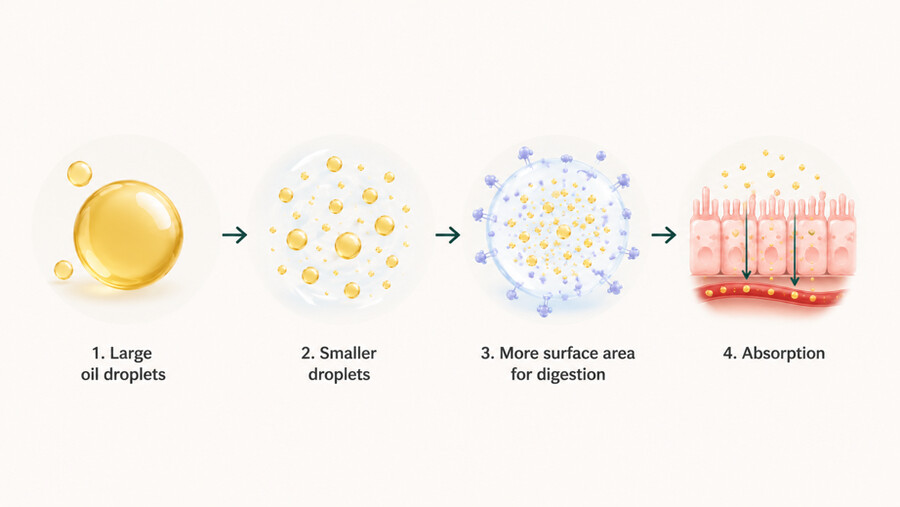
The same principle can also be applied to the design of an Omega-3 supplement.
In a traditional soft capsule, the fish oil is enclosed as oil inside the capsule. Concordix® takes a different approach. The Omega-3 oil is emulsified before intake and incorporated as small droplets in a gel matrix. In the published study, the majority of the oil droplets were roughly 2 to 4 μm in diameter.¹

In other words, the technology changes the physical form in which the Omega-3 is delivered.
The principle is simple: smaller oil droplets present a larger surface area to the digestive processes. Research on fat digestion has identified droplet size, emulsion structure and stability as factors that can influence lipolysis and bioavailability.¹
But a plausible biological mechanism is only the starting point. The more important question is whether the difference can actually be measured in the human body.
What does the research show?
A human bioavailability study compared the same triglyceride-based fish oil in two different forms: a gelled emulsion and traditional soft capsules. Both formulations contained fish oil from the same batch, which allowed the researchers to examine the effect of the delivery form itself.¹
Participants received a single dose, and blood samples were collected over the following 26 hours.¹
The study showed that the gelled emulsion produced a significantly greater plasma exposure of EPA and DHA combined, compared with the traditional soft capsule. Over the 26-hour study period, the incremental plasma exposure of EPA + DHA was 43.3% higher than with traditional soft capsules.¹
The researchers concluded that delivering triglyceride-based fish oil as a gelled emulsion can increase the bioavailability of Omega-3 fatty acids, with pre-emulsification considered a possible explanation for the observed difference.¹
Which brings us back to an important point: the amount of Omega-3 on the label is only part of the picture.
The formulation determines the physical form in which a nutrient meets the digestive system. For Omega-3, methods such as emulsification can change the oil's physical form and — as this study shows — influence its bioavailability.
A thoughtful formulation therefore looks beyond what goes into a product. It also considers how the nutrients are delivered once they enter the body.
Every step matters.
Reference
- 1. Haug IJ, Sagmo LB, Zeiss D, Olsen IC, Draget KI, Seternes T. Bioavailability of EPA and DHA delivered by gelled emulsions and soft gel capsules. European Journal of Lipid Science and Technology. 2011;113(2):137–145. DOI: 10.1002/ejlt.201000450.

Lutein and bilberries: What does the science say?
Check more
What makes a good Omega-3 product for children?
Check more
newsletter